Monitoring Data Foundation (MDF)
The MDF or Monitoring Data Foundation brings master data (Data Platform) together with bespoke views of data that end users need to execute proactive technical monitoring. This approach of establishing the data fabric across monitoring data use cases ensures less siloed data creation and more integrated knowledge retention, supporting Shell’s data management strategy.
- The MDF, streamlines the transition from Technical Monitoring planning to execution. This technology optimizes efficiency, reducing the time required for implementation. By seamlessly integrating planning and execution processes, MDF enhances the overall monitoring workflow, facilitating quicker and more effective technical monitoring initiatives.
- The MDF seamlessly integrates with diverse data sources, empowering business users to tailor hierarchies according to the specific needs of consuming applications. This versatility allows for a customized and adaptable approach, facilitating efficient data processing. By providing users with the flexibility to configure hierarchies based on consuming applications, MDF ensures a more personalized and targeted utilization of monitoring data, enhancing the overall effectiveness of the monitoring and analysis process.
- The interface of this system is highly adaptable, managing diverse hierarchies (asset structure mapping) from various sources. It efficiently transforms them into a unified output, facilitating user-friendly computation of models. This flexibility streamlines data integration, enabling seamless processing and analysis for enhanced modeling capabilities.
- The data foundation integration layer facilitates the sharing of technology-driven insights across multiple data platforms like AIF/CIF, EDW, RTDIP, and Digital Twin. This seamless integration ensures a cohesive flow of information, enabling efficient communication and collaboration. By connecting diverse data sources, this layer enhances the accessibility and utilization of insights, promoting a unified approach to technological intelligence across platforms and contributing to a more cohesive and informed decision-making process.
- Ensuring data quality and integrity across real-time data streams is achieved in tandem with PI Data Quality. This collaborative approach enhances the accuracy and reliability of real-time data, fostering a robust foundation for informed decision-making and analysis.
Use Cases:
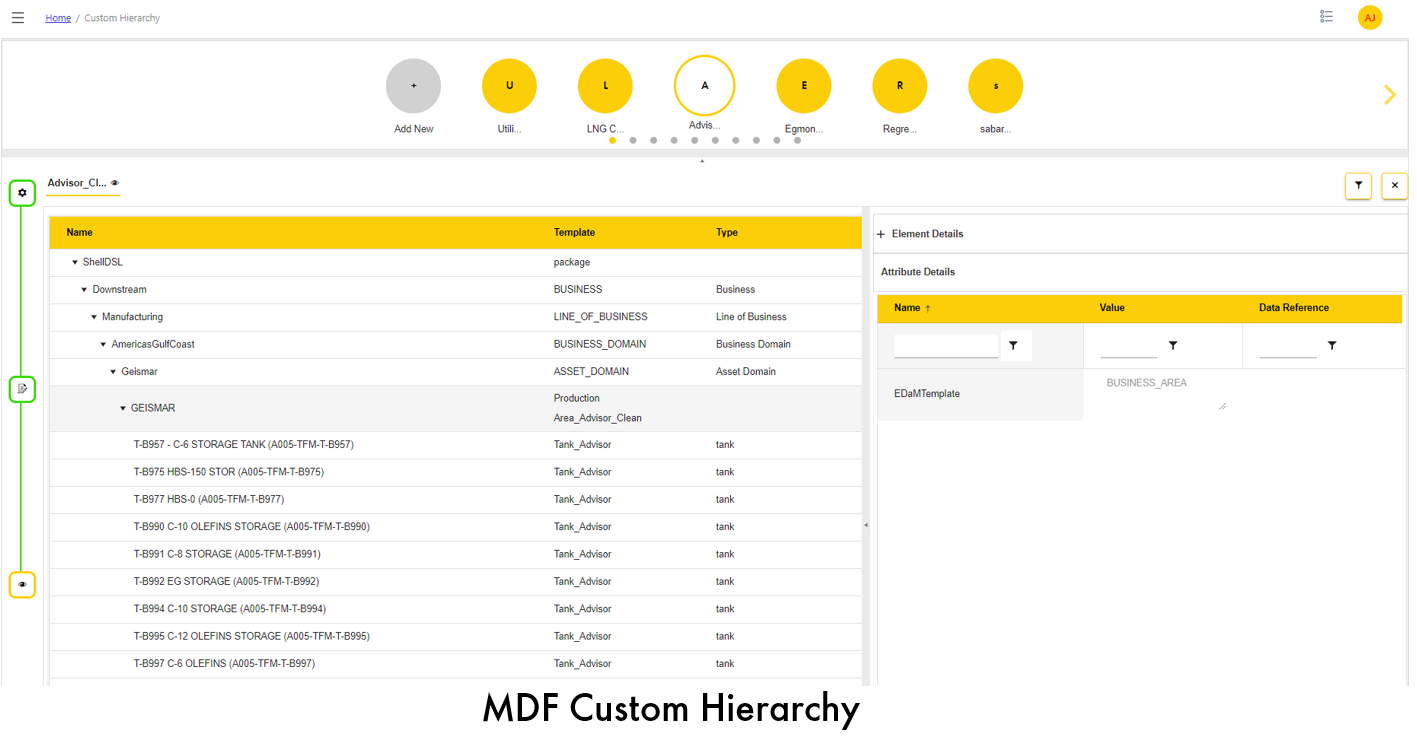
Custom Hierarchy
Custom hierarchies are the resulting transformation on base hierarchy data and the profiles applied to the various elements resulting in attributes being populated and or transformed resulting in a targeted set of hierarchy data meant for the targeted use case.The customization process leads to a more focused and targeted set of hierarchy data, providing decision-makers with the necessary insights to make informed and strategic decisions
Self-service
Engineers (PTM Global centers, assets, plants) understand the data they require to execute proactive monitoring, and the self-service capability of the MDF gives them the opportunity to configure new data relationships themselves in an easy-to-use self-service portal.
Enhanced data sharing
Truly configure input data once and re-use many times for each monitoring use case, be it analytics (ad hoc calculations, simple / advanced analytics, 1st principal models, predictions) or visualization (templated)
Silos Of Master Data
The MDF ingests master data from AIF MDS (for UPIGNE and DS P&C excl. Unconventional data), CIF MDS (Unconventional), RTDIP and EDW forming the base hierarchy data set. By incorporating this data, it establishes a comprehensive hierarchy, enabling a more holistic view of the data. This streamlines the process of updating and managing master data, saving time and resources.